 Sage.is
For sixteen years, Dave Bouskill and Debra Corbeil wrote about the world. The couple from Paris, Ontario, had launched The Planet D in 2008 after cycling the length of Africa, and over the next decade and a half they built it into one of the most recognized independent travel publications on the internet. A hundred and thirty countries. All seven continents. City guides, adventure itineraries, packing lists, hotel reviews, the accumulated knowledge of two people who had spent their adult lives going places and writing down what they found. Forbes named them among the top ten travel influencers in the world.[1] Reader's Digest, the BBC, and AdWeek gave them best travel blog honors. The Society of American Travel Writers awarded them gold, twice. At its peak, The Planet D drew over a million visitors a month, employed an editor, writers, and a technical manager, and generated seven-figure annual revenue, most of it through advertising served by Google's own ad network.[2]
In May 2024, Google launched AI Overviews, and within months The Planet D's traffic fell by half.[3] The queries that had sustained the site for sixteen years (where to stay in Dubrovnik, how to pack for Patagonia, the best time to visit Kyoto) now returned a three-paragraph AI-generated summary at the top of Google's results page. The summary was assembled from The Planet D's own writing, from Lonely Planet, from a dozen other sites that had spent years building expertise. It was presented in Google's voice, in Google's interface, with Google's authority. The users read it. The users did not click. The website visit that would have generated an ad impression, a potential affiliate sale, a reason for the site to exist, never happened.
What followed was swift: A ninety-percent traffic collapse and layoffs. And in early 2026, The Planet D ceased publication entirely. "I feel betrayed," Bouskill said. "We built something for sixteen years, and it was gone within six months."[4] This is not unusual, this is the new pattern.
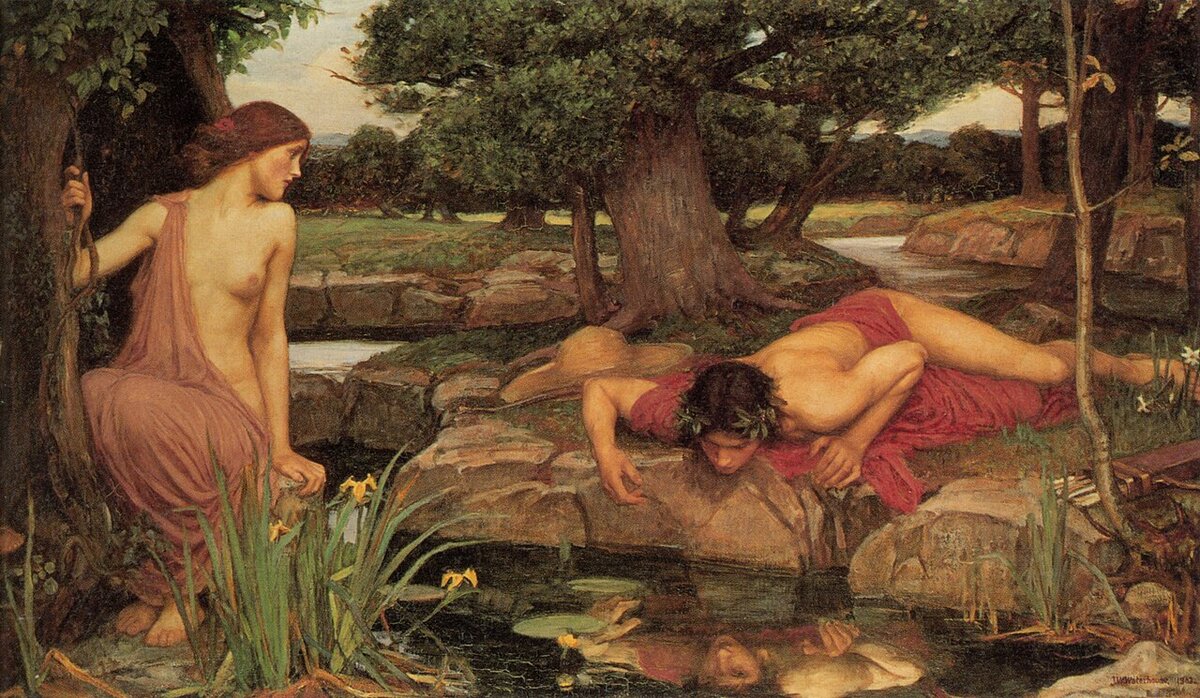
John William Waterhouse, "Echo and Narcissus" (1903). Walker Art Gallery, Liverpool. A voice that can only repeat what others have said, directed at a figure transfixed by his own reflection. Public domain.
The Doors That Disappeared
For most of its existence, the Google search engine was a directory. You typed in a search query, and it pointed you somewhere: ten blue links, ranked by relevance, each one a door to someone else's knowledge. You chose which door to open. You read what was behind it. You decided, consciously or not, whether the person who wrote it was worth trusting. That transaction is ending.
At Google I/O 2026, the company replaced its search bar with what it calls the "intelligent search box," a dynamically expanding, multimodal AI interface powered by Gemini 3.5 Flash that accepts text, images, files, video, and open Chrome tabs.[5] AI Mode, the conversational engine behind the new box, is now available in nearly two hundred countries across ninety-eight languages with no subscription required. It has surpassed one billion monthly users. Queries are doubling every quarter.[6]
The shift is not from bad search to good search. The engine that once helped you navigate to someone else's knowledge now removes attribution. It speaks that knowledge back to you in its own voice, with no indication that it belongs to anyone.
Liz Reid, Google's head of search, told NPR that the company still sends "billions of clicks" to publishers daily and that clicks from AI Overviews are "higher quality," producing longer user engagement.[7] Helen Havlak, publisher of The Verge, said her internal data contradicts that claim directly.[8] The numbers bear her out. Ninety-three percent of AI Mode queries end without a single click to an external website.[9] Only eight percent of users go looking for the original source.[10] Position-one organic click-through rates, the metric that determined whether a publisher lived or died, collapsed from 7.3 percent to 1.6 percent on queries where AI Overviews appear.[11]
When the answer has no author, and the author can no longer afford to exist, what is the answer actually worth?

Pieter Claesz, "Vanitas Still Life" (1632). Mauritshuis, The Hague. An overturned glass, a guttering wick, a skull beside the books. Everything that once held value, emptied. Public domain.
The Source Goes Quiet
One travel blogger in Ontario is a casualty. The pattern is an industry.
Barbara Peng, the CEO of Business Insider, told her staff in May 2025 that the company needed to "endure extreme traffic drops outside of our control."[12] She then laid off twenty-one percent of the workforce. Business Insider's organic search traffic had fallen fifty-five percent between April 2022 and April 2025.[13] The company scrapped the majority of its e-commerce operation, the division most dependent on search referrals, and announced a pivot to live journalism events and enterprise AI tools. The Insider Union called the layoffs "a brazen pivot away from journalism toward greed."[14]
HuffPost lost half its search referrals over the same period.[15] The New York Times saw its search traffic share fall from forty-four percent to thirty-seven percent.[16] The Mail Online watched its organic click-through rate collapse from thirteen percent on desktop and twenty percent on mobile to five and seven percent respectively.[17]
These are the large publishers, the ones with subscriptions, events, and brand recognition to fall back on. The small ones have nothing. Morgan McBride ran Charleston Crafted, a DIY home improvement blog. Her traffic dropped over seventy percent after March 2024. Advertising revenue fell sixty-five percent, costing tens of thousands of dollars. "You can't just sit around waiting for things to turn around," she said.[18] Scott Lapatine, the founder of Stereogum, a music blog that had operated for nearly two decades, watched seventy percent of his ad revenue disappear in a single year. He blamed Google's AI Overviews alongside Facebook and X's deprioritization of links.[19]
Chartbeat data tells the structural story. Small publishers (those drawing between one thousand and ten thousand daily page views) experienced a sixty percent decline in search referral traffic over two years. Medium publishers saw forty-seven percent. Large publishers, twenty-two percent.[20] The smaller you are, the harder you fall. And the smaller publishers are the ones who write about the things nobody else covers: the regional recipe, the niche hiking trail, the local history that no newsroom has a beat reporter for. When they disappear, the knowledge disappears with them.
Danielle Coffey, the leader of the News/Media Alliance representing over two thousand outlets, put it plainly:
"Google is using our content without compensation. It's parasitic, it's unsustainable, and it poses an existential threat."[21]
The Spiral
There is a feedback loop at work, and it has no natural exit.
- Google's AI synthesizes information from across the web.
- The synthesis replaces the visit.
- The visit generated the revenue.
- Without the revenue, the publisher contracts or closes.
- The AI then trains on whatever remains: thinner, lower-quality, less original.
- The answers degrade.
- But the degradation is invisible, because ninety-three percent of users never click through to compare the answer against its source.
Matthew Prince, the co-founder and CEO of Cloudflare, one of the companies that routes much of the internet's traffic, framed the problem in terms even the AI companies should understand:
"If content creators can't get compensated, they'll stop creating content."[22]
The data supports him. AI crawler-to-visit ratios have reached 250:1 and higher, compared to 2:1 for traditional search crawlers.[23] Bots now account for fifty-one percent of all web traffic, the majority of it AI-related.[24] The machines are reading the web more voraciously than ever. The humans those machines serve are visiting it less than ever. The economics of that equation do not balance.
Global publisher traffic from Google dropped by a third in 2025.[25] News publishers expect search referrals to fall forty-three percent by 2029.[26] Sixty-two percent of product discovery already happens on TikTok, Instagram, or YouTube rather than the open web.[27] Mobile users spend eighty-eight percent of their time in apps, not browsers.[28]
The web that Google was built to index is being hollowed out by Google. Fewer quality sources produce worse AI answers, which produce less reason to create quality content, which produces fewer quality sources. The information economy is eating its own seed corn.
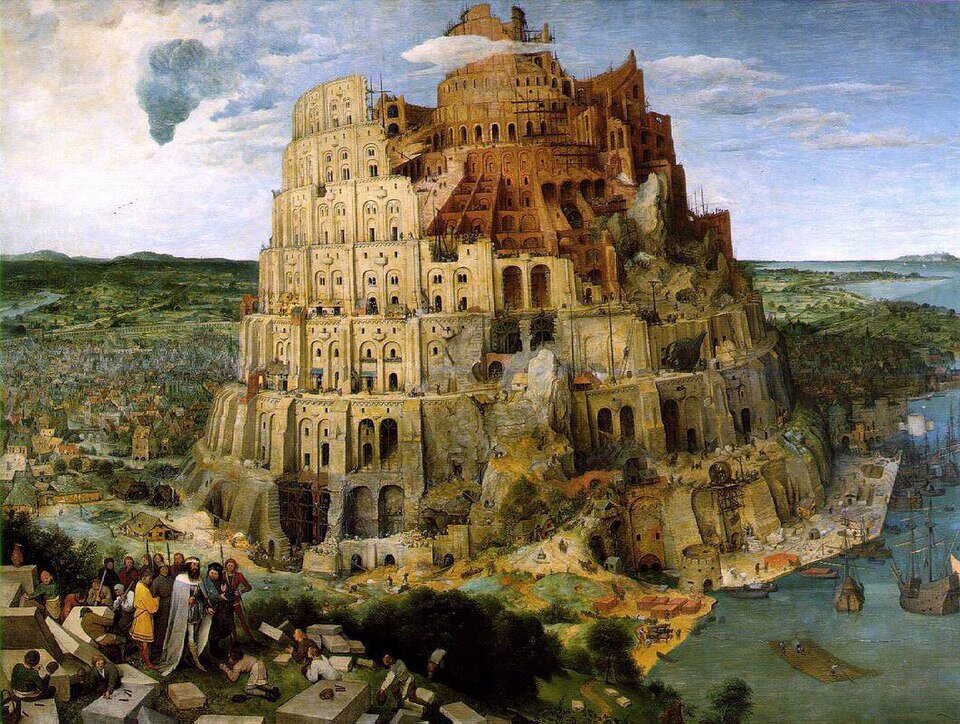
Pieter Bruegel the Elder, "The Tower of Babel" (1563). Kunsthistorisches Museum, Vienna. One structure, built to reach heaven, consuming everything around it. Public domain.
The Monopoly That Writes the Answer
No company on earth mediates more questions than this one. With approximately ninety percent of the global search market,[29] it faces no meaningful competitor in the link-based era it just ended. In August 2024, Judge Amit Mehta of the U.S. District Court for the District of Columbia ruled, in a 277-page opinion following a nine-week bench trial, that Google had violated the Sherman Antitrust Act by maintaining an illegal monopoly in internet search.[30] It was the most significant antitrust ruling against a technology company since the Microsoft consent decree.
Thirteen months later, in September 2025, Mehta delivered his remedies decision. He rejected the Department of Justice's most aggressive proposals, declining to force the divestiture of Chrome or Android. Instead, he banned exclusive default-search contracts, ordered Google to share certain search index data with third parties, and established a six-year technological oversight committee.[31] In his opinion, Mehta acknowledged that generative AI had "changed the course of this case" and wrote that competition in the AI space gave him reason for caution.[32]
The caution may be misplaced. The remedies were designed for a link-based era. They address the question of who appears in search results. They do not address the question of what happens when there are no search results at all, only an answer that echoes in Google's voice using other people's work.
Penske Media Corporation, the parent company of Rolling Stone, Variety, Billboard, The Hollywood Reporter, and Deadline, filed a fifty-six-page antitrust memorandum in the D.C. District Court in February 2026 arguing that Google engages in "coercive reciprocal dealing": accept AI scraping or become invisible in search results.[33] The European Union has designated Google a "gatekeeper" under the Digital Markets Act.[34] Google's appeal and the DOJ's cross-appeal are both before the D.C. Circuit.[35]
One company, already ruled an illegal monopoly, now speaks in a single voice to a billion people, using other people's work, without compensation, in a format designed to make the original source unnecessary.
What We Stop Doing
The deepest cost is not economic. It is cognitive. Betsy Sparrow, a psychologist at Columbia University, demonstrated in 2011 what she called the "Google Effect": when people know they can look something up online, they invest less effort in remembering it.[36] The finding was unsettling but contained. The information was still out there, on the other end of a search. The human still had to find it, read it, evaluate it. The act of searching was itself a cognitive process, a series of decisions about what to trust and why.
AI Overviews remove the act of searching. AI Mode removes the act of finding. The user receives a pre-packaged synthesis without encountering the sources, the disagreements, or the context that produced it. Researchers writing in Big Think have warned that we are "offloading cognition to AI," causing critical thinking to atrophy in the same way a muscle weakens from disuse.[37] A separate analysis in Psychology Today described AI-mediated knowledge as delivering "pre-packaged insights without asking for mental participation," producing passive consumption of machine-generated thought where active inquiry once existed.[38]
The homogeneity problem compounds the cognitive one. When a billion people ask the same question and receive the same synthesized answer, the diversity of interpretation that drives understanding disappears. Learning does not happen when everyone agrees. It happens when someone encounters a framing they had not considered, a source that contradicts their assumption, an argument that forces revision. A single AI-generated answer, delivered with the confidence of a textbook and the accountability of no one, forecloses that encounter.
Unlike a human expert, AI does not justify its reasoning. It does not refine its position through experience. It does not take responsibility for errors. And its errors are significant: Google's own internal analysis of Gemini 3 found it produced incorrect information twenty-eight percent of the time.[39] At five trillion annual searches, that translates to tens of millions of wrong answers every hour.[40] A Mount Sinai study found AI chatbots "highly vulnerable" to spreading harmful health misinformation.[41] Google's AI has claimed that Barack Obama was the first Muslim president, declared Hulk Hogan dead, and cited an April Fool's satire about microscopic bees powering computers as fact.[42]
When the answer has no author, you cannot evaluate the author's credibility. When you never visit the source, you never encounter the context the source provided. When one voice speaks for everyone, disagreement, the engine of thought, disappears.
Every Voice Wants to Be the Only Voice
The pattern extends far beyond one company. OpenAI's ChatGPT now processes 2.5 billion prompts per day across 900 million weekly active users, capturing roughly seventeen percent of all global digital queries, the first double-digit crack in Google's near-monopoly in two decades.[43] In 2026, OpenAI began running cost-per-click advertisements inside the chat interface itself.[44] The answer is the ad unit. The user never leaves. Microsoft made Copilot the default search handler for the Windows 11 taskbar, Start menu, and File Explorer in a January 2026 update.[45] Millions of searches that previously went through a browser are now handled by Copilot directly, pulling from Bing's index, presenting AI-generated summaries, often without the user realizing they have conducted a web search at all. The AI is not in the browser. It is the operating system.
Apple will unveil an AI answer engine called "World Knowledge Answers" at WWDC in June, transforming Siri from an assistant into an oracle that generates summaries blending text, images, video, and local results.[46] iOS 27 replaces "Hey Siri" with a "Search or Ask" prompt.[47] Apple partnered with Google to power it with a customized version of Gemini.[48] Two competing walled gardens. The same underlying voice.
Perplexity, valued at twenty-one billion dollars, has been sued by the New York Times, the BBC, and Reddit for large-scale content reproduction.[49] Cloudflare's research found Perplexity using undeclared "stealth" web crawlers to bypass web application firewalls.[50] The company's entire value proposition is that you never need to follow the links it cites. It calls this aggregation. Publishers call it extraction. The better Perplexity works, the less traffic flows to the people who created what it summarizes.
Meta has embedded AI directly into Instagram and Facebook, answering questions inside the app in under five seconds.[51] Instagram search now operates as a conversational AI engine: users discover content through AI-designed feeds, suggested creators, and natural-language queries rather than by browsing the open web.[52] The user never leaves. The source never gets visited. The pattern is the same across every company. Ingest the web. Dissolve authorship. Speak in a single voice. Keep the user inside the walls. They are not competing to give you better search. They are competing to be your source of truth, the one voice you trust so completely that you stop asking where the answer came from.
Sixteen Years and Six Months
On Google's own publisher showcase page, there is still a case study for The Planet D. "Thanks to ads, we've grown exponentially," Bouskill is quoted as saying. "Before using our ad network, we made a solid six-figure income, but thanks to a mixture of ads, affiliates and partnerships, we were able to push that into seven figures."[53]
The page does not mention that The Planet D no longer publishes. It does not mention the ninety-percent traffic collapse. It does not mention the layoffs, or the six months that undid sixteen years of work. Google's own case study for its own ad network now promotes a site that Google's own AI made economically unviable.
The couple is on YouTube now, creating video content for a platform owned by the same company that consumed their written work. They have rebuilt on Google's terms, inside Google's walls, subject to Google's next algorithmic decision. They are, in the language the industry uses without irony, pivoting.
Somewhere today, a person will type "best time to visit Kyoto" into Google's new intelligent search box. AI Mode will return a fluent, confident, three-paragraph answer. It will synthesize the accumulated knowledge of travel writers who spent years visiting Kyoto in every season, comparing temples in spring rain and autumn light, noting which ryokans are booked a year in advance and which shrines are empty at dawn. The answer will be adequate. It may even be correct. It will have no author. It will generate no visit. It will pay no one.
The person who knew the answer first is nowhere to be found.
Footnotes
Disclosure: Sage.is uses AI tools in its editorial and product workflows. This article was researched and drafted with AI assistance.
Forbes, "Top 10 Travel Influencers in the World," Forbes.com ↩︎
Dave Bouskill, quoted in Google for Publishers case study, google.com/ads/publisher/stories/the_planet_d/ ↩︎
"The Publisher Extinction Event: A Named-Casualty Report on How AI Search Dismantled the Open Web in 18 Months," Everything PR, everything-pr.com ↩︎
Dave Bouskill, quoted in "Dude, AI Ate My Traffic," IAB Tech Lab, iabtechlab.com ↩︎
"Google Search I/O 2026 Updates," Google Blog, blog.google ↩︎
Ibid. ↩︎
Liz Reid, quoted in "Online News Publishers Face 'Extinction-Level Event' from Google's AI-Powered Search," NPR, July 31, 2025, npr.org ↩︎
Helen Havlak, publisher of The Verge, quoted in ibid. ↩︎
"Google AI Mode 93% Zero-Click Rate," Nobori AI, nobori.ai ↩︎
"Zero-Click Search Statistics 2026," Digital Applied, digitalapplied.com ↩︎
"Google's AI Overviews and Publisher Traffic: How Antitrust Filing Reveals 58% Click Decline," ALM Corp, almcorp.com ↩︎
Barbara Peng, CEO of Business Insider, quoted in "Business Insider Will Lay Off 21% of Staff Amid AI Disruption and 'Extreme Traffic Drops Outside of Our Control,'" Nieman Journalism Lab, May 2025, niemanlab.org ↩︎
"The AI Search Reckoning Is Dismantling Open Web Traffic -- And Publishers May Never Recover," AdExchanger, adexchanger.com ↩︎
Insider Union, quoted in "Business Insider Goes 'All-In on AI,' Laying Off 21% of Staff," Yahoo Finance, finance.yahoo.com ↩︎
AdExchanger, ibid. ↩︎
Ibid. ↩︎
Carly Steven, Director of SEO and Editorial E-commerce, The Mail Online, cited in ibid. ↩︎
Morgan McBride, Charleston Crafted, quoted in "'Betrayed, That's the Word': Small Business Owners Reel as Google AI Destroys Google Search," ZeroHedge, zerohedge.com ↩︎
Scott Lapatine, founder of Stereogum, cited in AdExchanger, ibid. ↩︎
"Search Traffic Is Down 60% for Small Publishers: What the Chartbeat Data Reveals," ALM Corp, almcorp.com ↩︎
Danielle Coffey, News/Media Alliance, quoted in NPR, ibid. ↩︎
Matthew Prince, co-founder and CEO of Cloudflare, quoted in NPR, ibid. ↩︎
"Dude, AI Ate My Traffic," IAB Tech Lab, iabtechlab.com ↩︎
Ibid. ↩︎
"Global Publisher Google Traffic Dropped by a Third in 2025," Press Gazette, pressgazette.co.uk ↩︎
"News Publishers Expect Search Traffic to Drop 43% by 2029," Search Engine Land, searchengineland.com ↩︎
"Zero-Click Search Statistics 2026," Digital Applied, ibid. ↩︎
Ibid. ↩︎
"Google's 90% Search Monopoly Faces DOJ Breakup," Tech Insider, tech-insider.org ↩︎
United States v. Google LLC, No. 1:20-cv-03010 (D.D.C. Aug. 5, 2024). Judge Amit Mehta, 277-page opinion. complexdiscovery.com ↩︎
"In a Major Antitrust Ruling, a Judge Lets Google Keep Chrome but Levies Other Penalties," NPR, September 2, 2025, npr.org ↩︎
Judge Amit Mehta, quoted in "Federal Court Orders Remedies in Google Antitrust Case, Rejects DOJ Call for Breakup," DLA Piper, dlapiper.com ↩︎
Penske Media Corporation, 56-page opposition memorandum, U.S. District Court for the District of Columbia, February 12, 2026. Cited in "Penske Media Says Google's 'Forced Choice' Broke Longstanding Web Bargain," PPC Land, ppc.land ↩︎
"Robust Google Search Antitrust Remedies," Knight-Georgetown Institute, kgi.georgetown.edu ↩︎
Tech Insider, ibid. ↩︎
The Google Effect is the term coined by psychologist Betsy Sparrow and colleagues at Columbia University in a 2011 study published in Science. The research demonstrated that when people expect to have future access to information (e.g., via a search engine), they show lower rates of recall for the information itself but enhanced recall for where to find it. The study established that search engines function as an external memory system, changing not what we know but how we know it. Sparrow, B., Liu, J., & Wegner, D. M. (2011). "Google Effects on Memory: Cognitive Consequences of Having Information at Our Fingertips." Science, 333(6043), 776-778. doi.org/10.1126/science.1207745 ↩︎
"AI Eroding Critical Thinking," Big Think, bigthink.com ↩︎
"AI Weakens Critical Thinking -- and How to Rebuild It," Psychology Today, May 2025, psychologytoday.com ↩︎
"AI Overviews Misinformation at Unprecedented Scale," Futurism, futurism.com ↩︎
"AI Overviews Show Millions of Wrong Answers Every Hour," Popular Science, popsci.com ↩︎
"Google AI Overviews Health Misinformation," ALM Corp, almcorp.com ↩︎
Futurism, ibid. ↩︎
"ChatGPT vs Google Search in 2026: Market Share, User Data," QuickSEO, quickseo.ai ↩︎
"OpenAI Turns on Cost-Per-Click Ads Inside ChatGPT," Digiday, digiday.com ↩︎
"Copilot 2026: Microsoft's Multimodal AI in Windows and 365," Windows Forum, windowsforum.com ↩︎
"Apple to Launch AI Search for Siri in 2026," Search Engine Land, searchengineland.com ↩︎
"WWDC 2026 to Showcase Apple's AI Advancements," MacRumors, macrumors.com ↩︎
"Google's AI Could Power Apple's Siri at WWDC 2026," Explosion, explosion.com ↩︎
"Perplexity AI 2026: The $21B Answer Engine Reshaping Search and the Legal Battles That Define AI's Future," Programming Helper Tech, programming-helper.com ↩︎
Ibid., citing Cloudflare research published August 2025. ↩︎
"Boosting Your Support and Safety on Meta's Apps with AI," Meta, March 2026, about.fb.com ↩︎
"Instagram Algorithm Strategies 2026: AI & Meta Updates," Digital Trainee, digitaltrainee.com ↩︎
Dave Bouskill, quoted in Google for Publishers case study, google.com/ads/publisher/stories/the_planet_d/ ↩︎