 Sage.is

On a Wednesday morning in March 2026, a freelance copywriter in Portugal opened her laptop to find that three of her regular clients had cancelled their contracts in a single week. The reason, offered apologetically over email, was the same in each case: "We've moved to an AI-first content workflow." By Friday, she had visited the blogs of all three companies. What she found was identical in a way that only machines can be identical: the same cadence, the same hollow transitions ("In today's fast-paced digital landscape..."), the same ghostly absence of a person behind the prose. The articles ranked nowhere. They said nothing. They filled space.
She was not reading content. She was reading slop.
The Word That Named the Flood
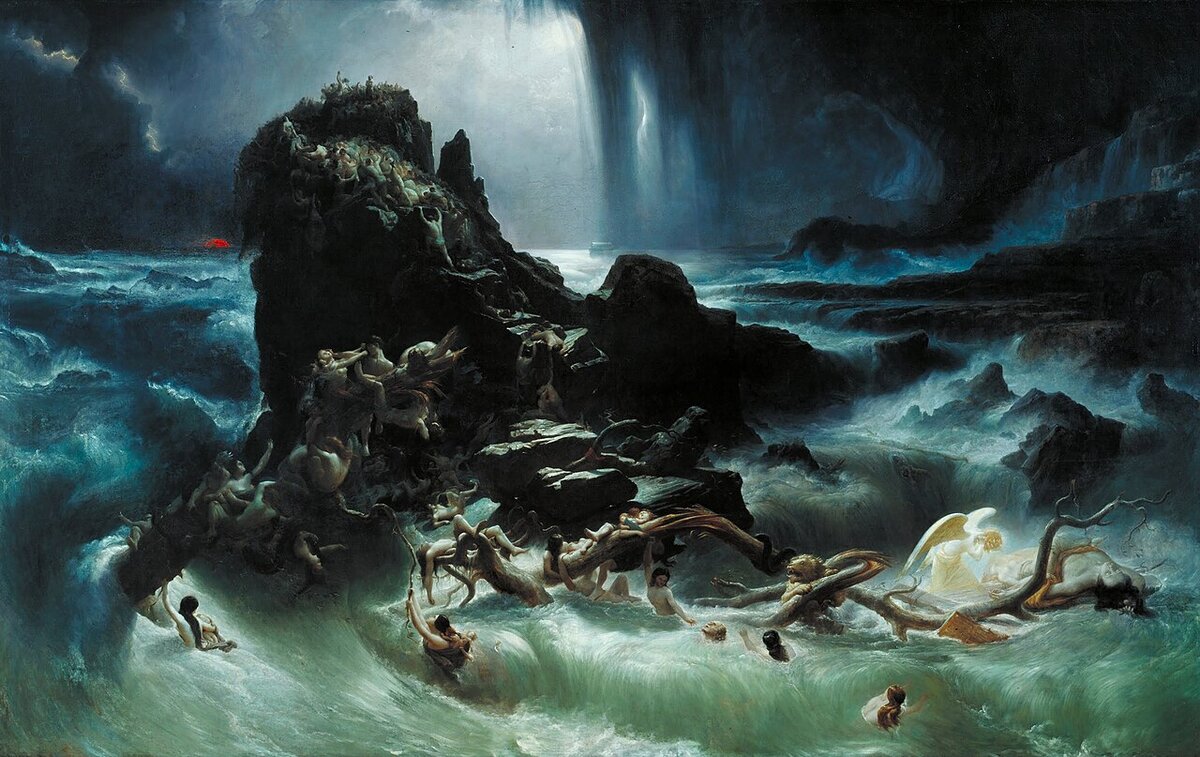
Francis Danby, "The Deluge" (1840). Tate Britain. The flood that erased everything indiscriminate. Public domain
In December 2025, Merriam-Webster announced its Word of the Year: "slop." The dictionary defined it as "digital content of low quality that is produced usually in quantity by means of artificial intelligence."[1] The word was not new. In the 1700s it meant soft mud. In the 1800s it came to mean food waste, pig slop, and then rubbish generally. But in 2025, it found its century. The mocking precision of the term captured something that more clinical language ("AI-generated content," "synthetic media") had failed to name: the visceral, immediate recognition that what you are reading was produced by nothing, for no one, with no purpose beyond filling a feed.
The numbers confirmed what readers already felt in their scrolling thumbs. Ahrefs analyzed nearly a million new web pages published in April 2025 and found that 74.2 percent contained detectable AI-generated content.[2] By mid-2025, the share of newly published AI versus human-written content had settled at roughly fifty-fifty. A study from the University of Florida found that the flood was turning off consumers while making it nearly impossible for professional writers, artists, and creators to stand out.[3]
The internet had not been democratized. It had been diluted.
The Prompt-and-Pray Workflow
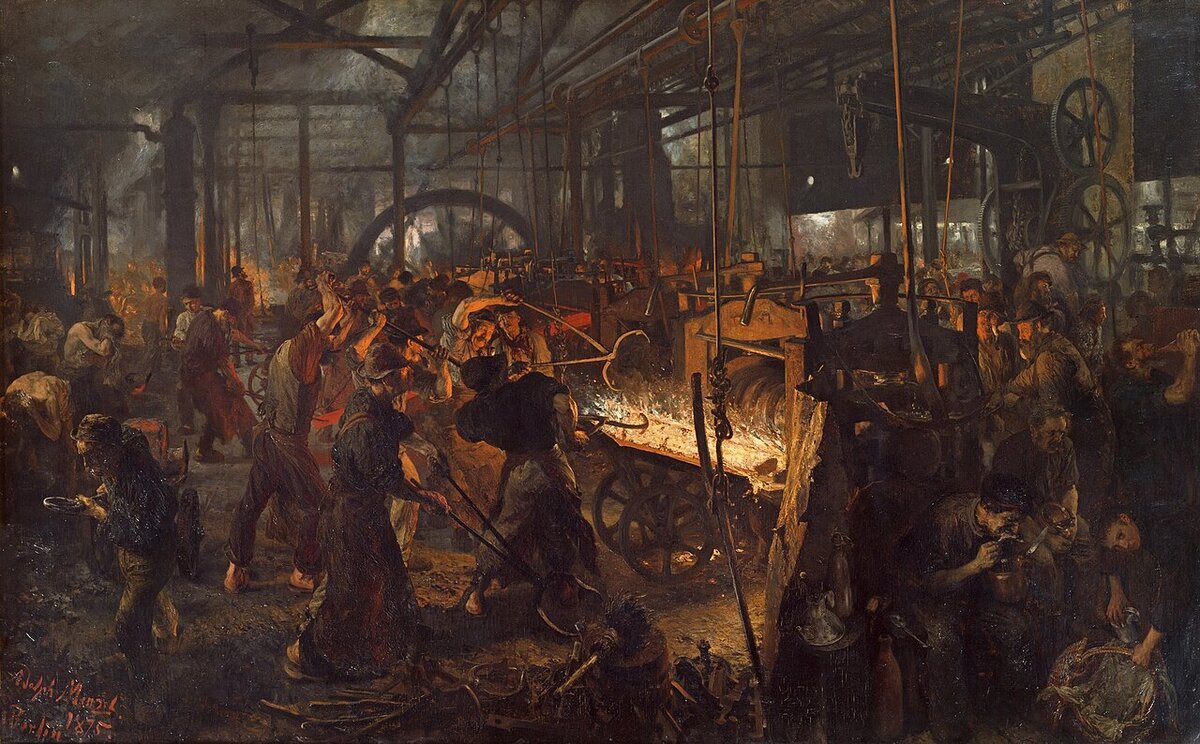
Adolph von Menzel, "The Iron Rolling Mill" (1875). Alte Nationalgalerie, Berlin. Mechanized production at scale, the workers barely visible. Public domain
The slop problem is not a technology problem. ChatGPT can write. Claude can reason. Perplexity can research with citations. The underlying models are, by any historical standard, extraordinary machines for generating coherent prose. The problem is what happens between the human and the machine: nothing.
The dominant workflow in 2026, if it can be called a workflow at all, looks like this: a person opens an AI chat app, types a vague instruction ("write me a blog post about productivity"), receives 800 words of frictionless mediocrity, and publishes it unchanged. There is no research phase. There is no thesis. There is no editorial pass. There is no human judgment applied at any point between the prompt and the publish button.
This is not writing with AI. This is dictation to a machine that has no taste, no argument, and no reason to care whether the output is true, useful, or worth a reader's time.
AI did not create the slop problem. The absence of a method did.
Ben Thompson, the independent analyst behind Stratechery, identified the dynamic early. Writing about AI-generated content in 2024, he noted that the bottleneck in publishing had shifted from production to judgment.[4] When producing words costs nothing, the only scarce resource is the ability to decide which words are worth producing and which ideas are worth sharing. That ability, editorial judgment, cannot be automated. It can only be practiced, developed, and applied by people who knows what they are trying to say and why.
The slop merchants skipped that step. And the internet noticed.
What the Method Looks Like

Johannes Vermeer, "The Lacemaker" (c. 1669-1671). Louvre, Paris. Attention, method, and human hands on the work. Public domain
The antidote to slop is not refusing to use AI. That ship sailed the moment a quarter-billion people signed up for ChatGPT. The antidote is structure: a workflow that treats AI as a collaborator with specific, bounded roles, and reserves for you the decisions that only a person can make.
The method has five stages. They scale from a student using Perplexity for a research paper to a professional using a purpose-built agent that can draft, audit, and publish. The tools change. The structure does not.
Research and workshopping come first.
You bring a concept. Your AI researches: pulling sources, finding data, identifying what has already been said. Then you workshop the angle together, through conversation. You shape the direction. The AI brings the evidence. A student might do this in ChatGPT, asking it to find counterarguments to their thesis. A professional might use Perplexity to pull cited sources, then move into Claude to stress-test the angle.
The critical move at this stage is the one that slop-producers skip entirely: deciding what the piece is about. Not the topic. The argument.
Next comes the pitch.
Before a word of the article is drafted, the structure is laid out: thesis, named sources, section order, working title. This is where you approve or reject the architecture. It is the blueprint inspection before construction begins. In a chatbot workflow, this might be a structured outline you iterate on with the AI. In an agent workflow, it becomes a filed document that the agent references throughout drafting.
Drafting follows, and only after the structure is approved.
The AI writes, following the agreed architecture, the style parameters, the grade level, the tone. But it writes a first draft, not a final product. The distinction matters. A first draft is raw material shaped by intent. Slop is raw material shaped by nothing.
Then the editorial pass, which is where the article becomes yours.
You read, rewrite, cut, add, restructure. The article belongs to you not because you typed every word, but because you made every decision about which words stayed, which were cut, and what was added that the machine could never have known to say.
Finally, publishing.
The article moves from draft to live, through whatever pipeline you use: a CMS, a static site, a newsletter. In a simple workflow, this means copying from a Google Doc. In an agent workflow, the agent moves the file, the sync script commits it, and the site rebuilds.
Five stages. One principle: you decide, the machine executes.
The Staircase
The method works at every level of technical comfort because the tools exist on a spectrum, and the workflow scales with them.
At the entry level, there are AI search enabled tools. Perplexity, for example, reliably searches the web with citations. It can summarize research and it can answer questions with sources attached. A student writing a term paper can use Perplexity to find three credible sources on a topic in two minutes instead of forty. That is the research phase, accomplished with a tool that requires no technical knowledge whatsoever.
At the middle level, there are AI tools that take the AI-enabled search and use them in conversation mode. This can be ChatGPT, Claude or our Sage.is in conversation mode. Perplexity can also do this to a limited extent. With these a writer brings their concept, has their AI research, and works with the AI to outline structure, draft sections, suggest transitions, and identify weaknesses. The writer iterates as a newsroom editor, maintaining control of the argument while offloading the mechanical labor of draft prose. This covers stages one through three.
At the advanced level, there are agents: software that can execute multi-step workflows autonomously.[5]. Hermies, an open-source research agent, can pull and synthesize dozens of sources into structured briefs.[5:1] Purpose-built writing agents can handle the full pipeline:
research with cited sources, workshop the angle through human directed conversation, draft to a style guide with defined reading level and tone, run an automated quality audit against measurable heuristics, and file the file output to the correct directory. The human enters at stage four, the editorial pass, to make the writing becomes theirs. The agent does not decide what is worth saying. It builds the scaffolding so the human can.
The staircase matters because the slop problem exists at every level. A student can produce slop with Perplexity (copy the summary, submit it as their own). A professional can produce slop with an agent (let it draft and publish without reading the output). The method is not the tool. The method is what you do with the tool.
The Quality Gate Nobody Builds
The most revealing absence in the slop workflow is the one that would cost the least to implement: a quality check between drafting and publishing.
Professional newsrooms have editors. Publishing houses have manuscript reviewers. Academic journals have peer review. But the person using ChatGPT to write their company blog has nothing between the output and the publish button, no structural checkpoint that tests whether the piece is specific, whether its claims are sourced, whether it says anything that has not been said a thousand times before in exactly this cadence.
Quality gates can be simple. Read the draft aloud. If three consecutive sentences start with "The," rewrite them. If no human being is named in the piece, it is not journalism, it is not reporting, and it is probably not worth reading. If the piece could have been written about any company in any industry by changing three proper nouns, it is slop.
Quality gates can also be automated. At Sage.is and Sage.Education , every article passes through a scripted audit before publication: heuristics measure sentence variation, passive voice density, paragraph diversity, opener variety, specificity of claims, and presence of named sources.[6] The scripts do not replace editorial judgment. They catch the patterns that human eyes glaze over on a third read-through. The heuristic scoring cannot tell you whether an argument is sound or an analogy lands. The scripts enforce a floor, not a ceiling. But a floor is precisely what the slop economy lacks.
The slop producers build neither kind of gate. They prompt, they accept, they publish. The absence of friction is the feature they are selling. But friction, applied at the right moment, is what makes writing worth reading.
The Ownership Question
There is a legal dimension to the method that most writers have not considered.
In August 2023, Judge Beryl Howell ruled in Thaler v. Perlmutter that works generated autonomously by AI cannot receive copyright protection. "Human authorship is a bedrock requirement," wrote Howell.[7] The D.C. Circuit upheld the ruling in March 2025. The U.S. Copyright Office elaborated: typing a prompt is not creative control. If the human's contribution is limited to describing what they want and accepting what the machine produces, the output belongs to no one.
The method solves this problem not as a legal strategy but as a natural consequence of its structure. A writer who shapes the thesis, approves the architecture, rewrites the draft, and makes editorial decisions at every stage has exercised creative control over the expressive elements of the work. The article is theirs, legally and intellectually, because the method required them to make it theirs.
Slop, by contrast, belongs to no one. It is not copyrightable. It is not ownable. It is, in the eyes of the law, an orphan, produced by a machine at the instruction of a person who contributed nothing that the law recognizes as authorship.
Consider the result: the people who use AI without a method are producing work they cannot legally claim as theirs. The people who use AI with a method are producing work that is unambiguously theirs.
The Real Democratization
The promise of AI writing tools was always democratization: anyone can publish, anyone can be a writer, the gatekeepers are gone. And the gatekeepers are gone. But what replaced them was not a thousand new voices finding their audience. What replaced them was a flood of voiceless content that sounds like everyone and no one, content that readers want to scroll past, that search engines are trying to bury, that communities from Hacker News to Reddit are learning to ban.
The real democratization is not the removal of friction from publishing. It is the availability of tools that make the hard parts of writing, the research, the structuring, the iteration, faster and more accessible to people who could not previously afford an editor, a research assistant, or a month of uninterrupted writing time. A student in Nairobi has access to the same research tools as a journalist in New York. A first-generation professional can workshop their thesis with an AI that never tires, never condescends, and never charges by the hour.
But only if they bring a method. Only if they bring judgment. Only if they understand that the AI is the instrument, not the musician, and that an instrument played without skill produces noise, not music.
The Copywriter in Portugal Has a Method Now
The freelance copywriter in Portugal did not quit. She spent two weeks studying how AI tools worked, not as replacements for her writing, but as collaborators within a structured process. She built a personal workflow: researching with AI, workshopping the angle with AI, but with editorial control at every transition, then editing the entire piece in her voice before publishing.
Within a month, two of her three former clients came back. The AI-first content workflows they had adopted were producing exactly what the internet had too much of already: empty, forgettable prose that ranked nowhere and spoke to no one. What they needed, it turned out, was not a machine that could write. It was a writer who knew how to use a machine.
The slop problem has a solution. It is not better AI. It is not more AI. It is a method that puts the human back where the human belongs: in the chair where decisions are made, with a machine that does everything except the one thing that matters:
The deciding.*
Footnotes
Disclosure: The views expressed are those of the editorial board and do not necessarily reflect the positions of any institution mentioned. Sage.is AI-UI and Sage.Education are products of Startr LLC; their inclusion represents a disclosure of interest. This article was researched and drafted using AI tools within the structured workflow it describes. The editorial decisions, thesis, structural choices, and final prose are the author's. The method is the message.
Merriam-Webster, "Word of the Year 2025: Slop," December 2025. merriam-webster.com ↩︎
Ahrefs study of AI-generated content, April 2025. Reported in multiple sources including Futurism and Amra and Elma, "AI-Generated Content Statistics 2026." amraandelma.com ↩︎
University of Florida News, "'AI slop' hurts consumers and creators. But high-quality AI could help both," March 2026. news.ufl.edu ↩︎
Ben Thompson, "Content and Community," Stratechery, 2025. Thompson argues that AI has achieved "total content commoditization" and that the bottleneck has shifted from production to judgment. stratechery.com ↩︎
Agents are AI systems that can execute multi-step tasks autonomously, not just answer questions. They range from open-source research tools like Hermies to full writing-and-publishing pipelines. The trade-off is complexity: agents require configuration, clear instructions, and a human who understands what the agent is doing well enough to catch when it goes wrong. They are not plug-and-play. ↩︎ ↩︎
The quality audit at Sage.is scores articles across eleven dimensions. The full pipeline (from research and workshopping through drafting, quality gate, and publishing) is the method this article describes, practiced daily. The audit scripts are open to inspection; the scores for this article are published alongside it. ↩︎
Thaler v. Perlmutter, No. 22-cv-01564 (D.D.C. Aug. 18, 2023), affirmed D.C. Circuit, March 2025. U.S. Copyright Office, "Copyright Registration Guidance: Works Containing Material Generated by Artificial Intelligence," Part 2, January 2025. ↩︎