 Sage.is
The Licence Nobody Teaches
In 2013, Tom Preston-Werner, the co-founder of GitHub, gave a sponsored keynote at OSCON, the O'Reilly Open Source Convention. He displayed the full text of the MIT licence on screen. It was short. It was clean. "Nice and short," he told the audience. Then he displayed the GNU General Public Licence, version 3. The text filled the screen and kept scrolling. "It's so long," Preston-Werner said. "That's not what freedom is."[1]
That same year, GitHub launched choosealicense.com, a site designed to help developers pick an open-source licence. The front page presented three options in a left-to-right layout, naturally read in order of priority. The first option was MIT.[2]
Twelve years later, MIT accounts for roughly 40 percent of all licensed repositories on GitHub.[3] The GPL family has fallen to approximately 10 percent. The decade before, the ratio was the opposite: 59 percent copyleft and 41 percent permissive.[4] In a single decade, the entire open-source licensing landscape inverted.
The inversion was not an accident. It was the prescription and the curriculum.
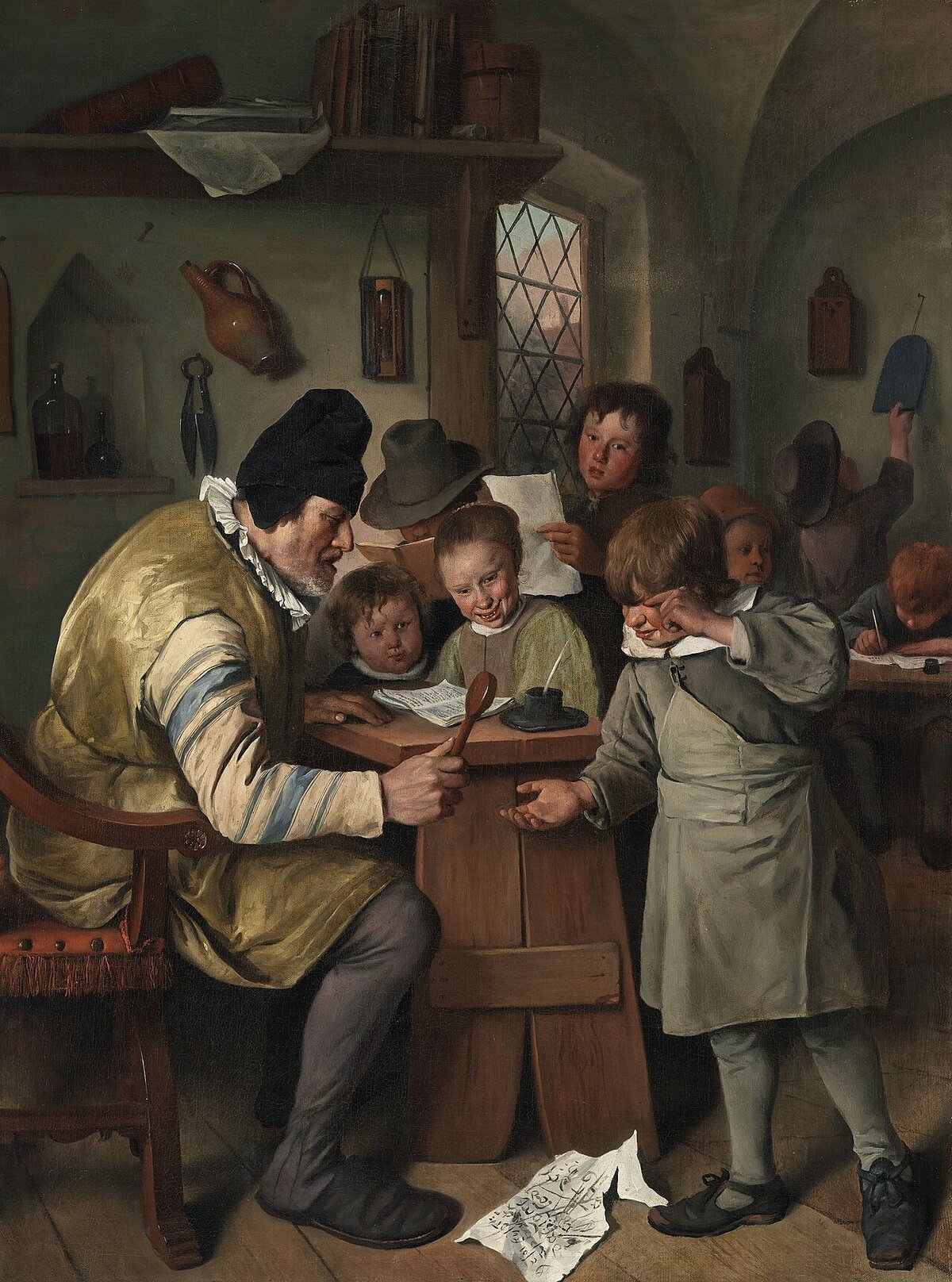
Albert Anker, "The Village School" (1896). Kunsthaus Zurich. The students learn what the teacher puts in front of them. What the teacher omits, they never encounter. Public domain.
The 170 Words
The MIT licence is 170 words long. It fits on a business card. It says: do whatever you want with this code, keep the copyright notice. That is the entire obligation.[5]
It does not say: share your modifications.
It does not say: if you build a service on this code, your users have any rights.
It does not say: if you train an AI model on this code, the author is informed.
It does not say: if Amazon takes this code and builds a billion-dollar managed service that competes with you, you have any recourse.
The GPL v3 is 5,600 words.[6] It says all of those things, or versions of them.
The GPL requires that modifications to the code be shared under the same licence.
Every subsequent user inherits the freedom to use, study, modify, and distribute the software.
By design, the GPL licence that prevents the scenario every open-source developer fears: a well-funded company taking your work, improving it privately, and out-competing you with your own code.
The AGPL adds one more provision: if you run the code as a network service,[7] your users must be offered the source. This closes the loophole that cloud computing created. The horrid loophole that lets Amazon run your GPL code as a web service without triggering the share-alike requirement, because technically no binary was "distributed."
Students learn about MIT in fifteen minutes. They learn about GPL almost never. They learn about AGPL never. The asymmetry is not pedagogical but structural.
The Curriculum Gap
No major computer science curriculum teaches comparative open-source licensing. Students learn to write code, version it in Git, test it, deploy it to the cloud, and choose a licence by clicking (usually) the first option on a dropdown menu populated by choosealicense.com.[8]
They graduate likely having never read a licence. Never compared the implications of permissive versus copyleft.[9] Never considered what happens when the weekend project they open-sourced under MIT gets incorporated into a product by a company with a hundred engineers and a legal team. Never understood that the 170 words they clicked through were a permanent, irrevocable gift of their work's legal protections.
The omission is not neutral. The companies that benefit most from permissive licensing (Google, Amazon, Meta, Microsoft) fund university computer science programs, sponsor hackathons, run fellowship programs, and donate tools to classrooms.[10] Their open-source projects (React, TensorFlow, VS Code, PyTorch) all use permissive licences. The ecosystem they build normalizes MIT and Apache as the default. The students who emerge from that ecosystem carry the default with them.
The curriculum doesn't teach licensing because the companies that fund the curriculum benefit from the licence the students choose by default.
- Alexander Somma
What Salvatore Built, and What Amazon Took
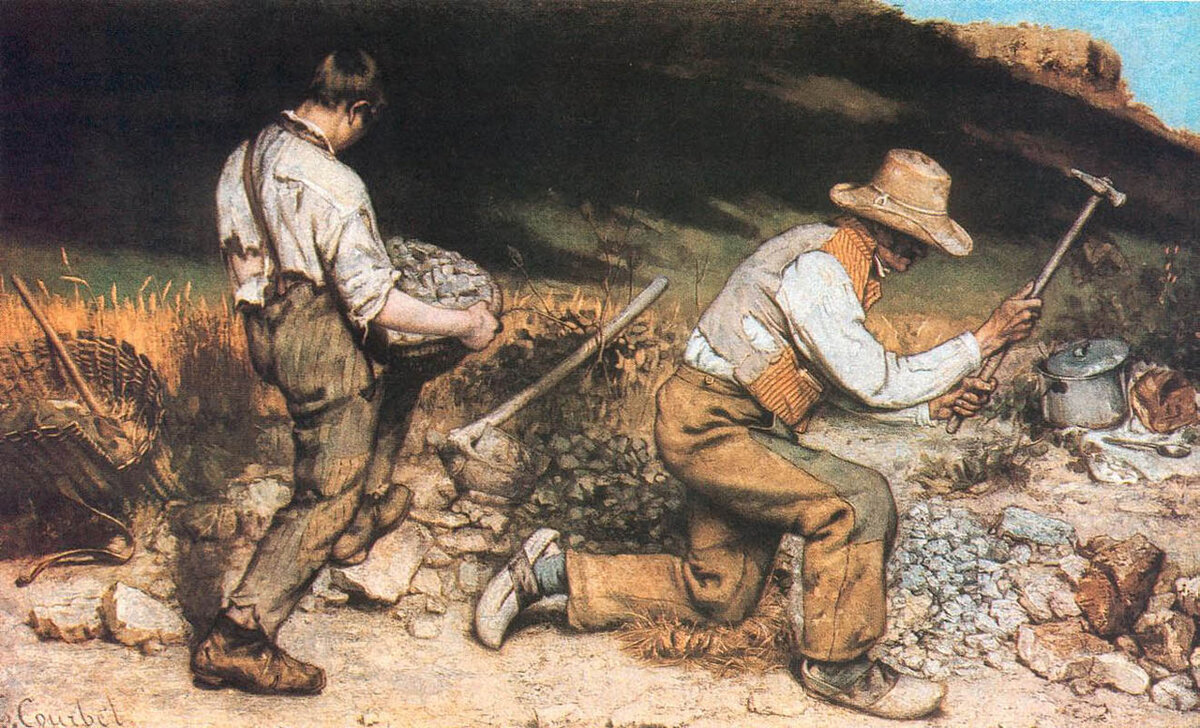
Gustave Courbet, "The Stone Breakers" (1849). Destroyed 1945. The workers build the road. Someone else drives on it. Public domain.
Salvatore Sanfilippo wrote Redis in 2009. He released it under the BSD licence, which is permissive, like MIT, with essentially no restrictions on use.[11] Redis became one of the most widely used databases in the world. By 2024, it powered caching, messaging, and session management for millions of applications.
Amazon built ElastiCache, a managed Redis service on AWS. Amazon did not write Redis. Amazon did not maintain Redis. Amazon took Sanfilippo's BSD-licensed code, deployed it on Amazon's infrastructure, charged Amazon's customers for access, and returned nothing to Sanfilippo or the Redis community.[12] The BSD licence permitted this. That was the point of the licence. Sanfilippo had chosen it.
Redis Ltd. changed the licence in March 2024. New versions of Redis would ship under a dual licence that included the Server Side Public License (SSPL) – a licence specifically designed to prevent cloud providers from offering the software as a service without sharing their modifications.[13]
The community fractured. The Linux Foundation forked the last BSD-licensed version as Valkey. Amazon backed the fork. Dawn Foster, director of data science at CHAOSS, found that the number of external contributors with five or more commits to Redis dropped to zero in the first six months after the relicensing.[14]
Sanfilippo returned to Redis in December 2024. He openly favoured full open-source licensing. In May 2025, Redis added the AGPLv3 – the licence that would have prevented the entire crisis, had it been chosen in 2009.[15]
The story took sixteen years. The lesson takes one sentence: the licence you choose on day one determines who profits on day ten thousand.
The Pattern
Redis is not unique. The pattern has repeated with the mechanical regularity of a bug in production:
Elastic released Elasticsearch under Apache 2.0. Amazon forked it, built OpenSearch, and competed directly. Elastic switched to SSPL in 2021. The community split. Elastic returned to AGPL in 2024.[16]
HashiCorp released Terraform under MPL (a weak copyleft). Cloud providers built managed Terraform services. HashiCorp switched to BSL (source-available, not open-source) in August 2023. The community forked to OpenTofu.[17]
Every case follows the same arc: permissive licence → widespread adoption → cloud provider extraction → panic → restrictive relicensing → community fracture. Every case could have been prevented by choosing the AGPL from the start.
The Google Ban That Became a Religion
Google published an internal policy in 2010 prohibiting the use of AGPL-licensed software across the company.[18] The reasoning was specific to Google's architecture: Google runs virtually everything as a network service, and Section 13 of the AGPL requires that anyone running AGPL code as a network service make the modified source available to users. For a company whose entire business depends on proprietary modifications to open-source infrastructure, this was an existential constraint.
Google also operates one of the largest monorepos in the world — a single repository containing billions of lines of code, where dependencies are shared and linked across projects. In a monorepo, the boundaries between "separate programs" blur. Introducing AGPL code into that environment risks copyleft obligations propagating across an unknowable number of internal services. Their ban was not just about network services, it was about the architecture of Google's entire codebase.
The AGPL ban was only rational for Google. Then the rest of the industry copied it.
Heather Meeker, a general partner at OSS Capital and the author of Open Source for Business, has spent two decades correcting the resulting confusion. "The single most significant misconception about copyleft licenses," Meeker wrote, "is caused by the use of the word 'viral.'"[19] The metaphor implies that copyleft spreads through contact, infecting any code that touches it. There is no legal mechanism by which this occurs. The Free Software Foundation's GPL FAQ addresses it directly: "Pipes, sockets, and command-line arguments are communication mechanisms normally used between two separate programs."[20] Separate programs communicating over standard interfaces do not form a combined work. The copyleft does not cross the pipe.
The ban was rational for one company. Then it became gospel for an entire industry, because reading a policy is easier than reading a licence. The result is a generation of developers who avoid the one licence designed to protect them, based on a prohibition they do not understand, created by a company whose interests are the opposite of theirs.
One company banned AGPL because it worked. The industry banned AGPL because that company did. Developers avoid AGPL because the industry does. Nobody in the chain read the licence.
The Copyleft Comeback
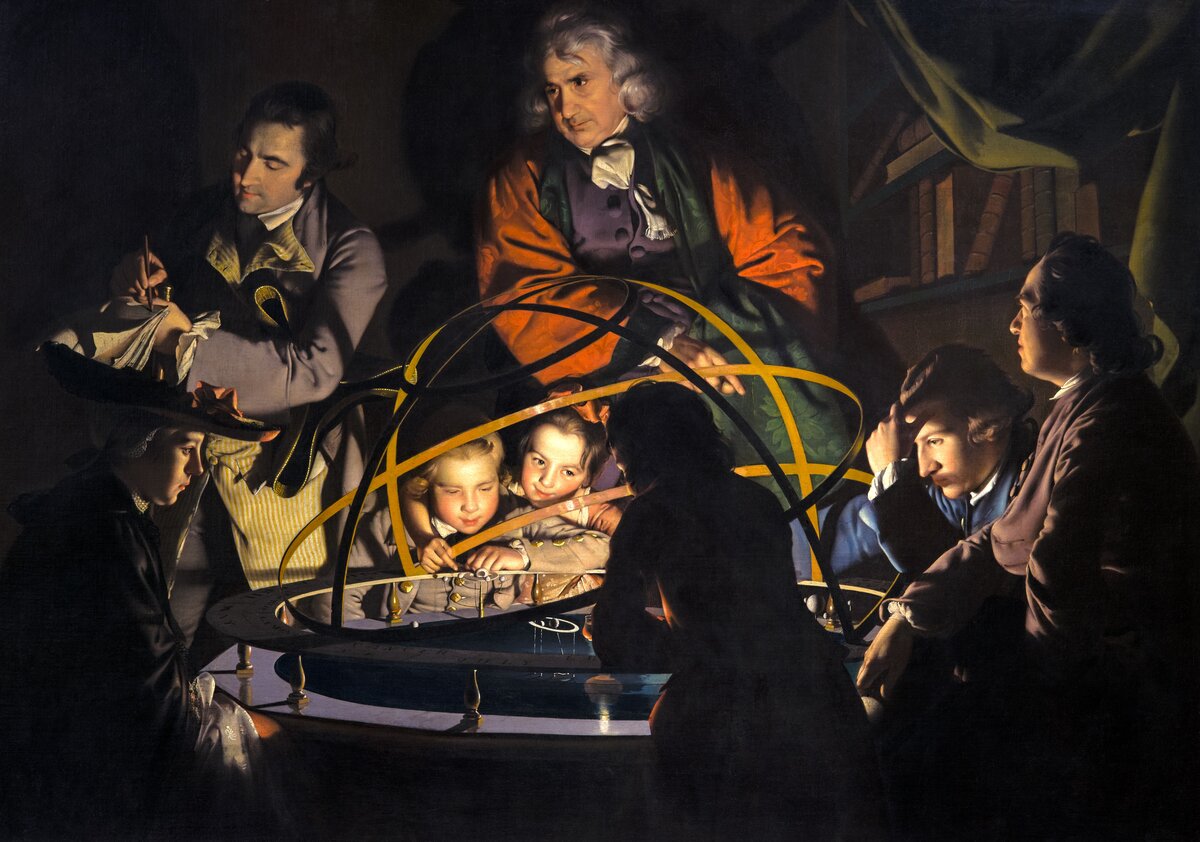
Joseph Wright of Derby, "A Philosopher Lecturing on the Orrery" (c. 1766). Derby Museum and Art Gallery. Understanding the mechanism changes everything. Public domain.
Now, something is shifting.
RedMonk's 2026 State of Open Source Licensing report found that permissive licensing declined from 82 percent to 73 percent between 2022 and 2025 – the first reversal in over a decade.[21] Elastic returned to AGPL. Redis adopted AGPL. Nextcloud invested 250 million euros in sovereignty infrastructure, all AGPL-licensed.[22]
Vitalik Buterin, co-founder of Ethereum, published a blog post in July 2025 explaining why he had changed his mind about software licensing. After years of advocating for permissive licences, Buterin now favoured copyleft. His reasoning was mathematical: "Fundamentally, if you assume economies of scale, then by simple mathematical reasoning, nonzero openness is the only way that the world does not eventually converge to one actor controlling everything."[23]
The AI dimension accelerates the urgency. MIT-licensed code can be used to train language models without attribution, without sharing the training data, and without releasing the model weights.[24] The original authors receive no notification. A study published on arXiv found that top-performing code-generation LLMs produce output that is "strikingly similar" to existing open-source code a portion of the time.[25] The 170 words of the MIT licence have become the legal mechanism by which open-source developers unknowingly subsidize proprietary AI models.
One Lecture
The fix is not complicated. It is a one lecture discussion, with one comparison table. One discussion of what happens when Amazon or Google take your code.
The table looks like this:
| MIT | GPL v3 | AGPL v3 | |
|---|---|---|---|
| Commercial use | ✔ | ✔ | ✔ |
| Modification | ✔ | ✔ | ✔ |
| Distribution | ✔ | ✔ | ✔ |
| Must share modifications | ✘ | ✔ (if distributed) | ✔ (if distributed OR served) |
| SaaS loophole closed | ✘ | ✘ | ✔ |
| AI training restricted | ✘ | Debatable | Stronger argument |
| Protects against cloud extraction | ✘ | Partially | ✔ |
All three licences permit commercial use. All three permit modification. All three permit distribution. The difference is what happens to the modifications: MIT says nothing. GPL says share them if you distribute. AGPL says share them if you distribute OR serve them over a network.[26]
Sage.is AI-UI uses AGPL-3.[27] So does Mastodon. So does Nextcloud. So does Matrix. So does Grafana. Our choice is deliberate: if anyone takes the code, modifies it, and runs it as a service, the modifications come back to our community. The licence ensures that the commons stays common.
The lecture shouldn't take more than forty-five minutes. The table fits on one slide. The Redis case study takes five minutes to review. The choosealicense.com origin story takes maybe two. The result: a developer who understands that choosing a licence is not a formality. It is a decision about who profits from their work.
Sadly, no university currently teaches this lecture, although every university should.
OUR ALTERNATIVE 170 Words
The MIT licence is 170 words. It fits on a business card. It gives everything away.
The AGPL is 14,000 words. Almost nobody reads it. So here it is in our 170 words for you to read, share, and use:[28]
Copyright (c) [year] [copyright holders]
Permission is hereby granted to any person obtaining a copy of this software and associated documentation files, to use, copy, modify, merge, publish, distribute, sublicense, and sell copies of the software, including for commercial purposes, subject to the following conditions:
If you distribute this software, or any work derived from it, you must release the complete source code under this same licence. If you modify this software and users interact with your version over a network — as a web application, an API, or a hosted service — you must offer those users the complete source code of your version, at no charge. All copies must include this copyright notice and this licence. You may not impose additional licence restrictions beyond this.
These permissions are irrevocable and royalty-free for the term of copyright. THE SOFTWARE IS PROVIDED "AS IS," WITHOUT WARRANTY OF ANY KIND. This is a plain-language summary. The full legal text of the GNU Affero General Public License, version 3, governs all use for you.
Same rights. Same freedoms. Same business card. The only difference: when someone takes your code and builds a service on it, the improvements come back. That is the entire addition. That is what the AGPL's full 14,000 words protect, and what our 170 words make clear and fair.
Disclosure
This article examines the structural factors behind the dominance of permissive open-source licensing and the educational gap that perpetuates it. The author uses AGPL-3 for Sage.is AI-UI. Heather Meeker is quoted from published works. Tom Preston-Werner is quoted from a public keynote. Vitalik Buterin is quoted from a public blog post. None were interviewed for this article.
The views expressed are those of the editorial board. Sage.is AI-UI is a product of Startr LLC and uses AGPL-3 licensing. Tom Preston-Werner, Heather Meeker, and Vitalik Buterin are quoted from public speeches and published works; none were interviewed for this article. Full disclosure and transparency is a feature, not a bug.
Tom Preston-Werner, GitHub co-founder, sponsored keynote at OSCON 2013. Displayed MIT licence ("nice and short") alongside full GPL v3 text ("it's so long, that's not what freedom is"). Reported in Opensource.com review of choosealicense.com. ↩︎
choosealicense.com, launched 2013 by GitHub. Front page presents three licence options left-to-right with MIT as the first. The site's catalogue is vendored into Licensee, which GitHub uses for its licence chooser when creating repositories. GitHub repository. ↩︎
GitHub Innovation Graph 2025. MIT accounts for approximately one-third of all licensed repositories on GitHub. ↩︎
Licensing ratio inversion: 2012 was 59% copyleft / 41% permissive. 2022 peaked at 82% permissive. 2025 declined to 73% permissive. The Register. RedMonk 2026. ↩︎
MIT licence: a permissive open-source licence consisting of approximately 170 words. It permits use, copying, modification, merging, publishing, distributing, sublicensing, and selling copies of the software, with the sole condition that the copyright notice and permission notice are included in all copies. It imposes no obligation to share modifications or provide source code. ↩︎
GPL v3 (GNU General Public License, version 3): a copyleft licence consisting of approximately 5,600 words. It permits the same uses as MIT but additionally requires that any distributed derivative works be licensed under the same GPL terms, ensuring that modifications remain available to the community. Published by the Free Software Foundation in 2007. gnu.org/licenses/gpl-3.0.html. ↩︎
AGPL v3 (GNU Affero General Public License, version 3): extends the GPL v3 with Section 13, which requires that anyone running AGPL-licensed software as a network service (SaaS, web application, API) must offer the source code to users interacting with it remotely. This closes the "SaaS loophole" – the gap that lets cloud providers run GPL code as a service without triggering the share-alike requirement because no binary is technically "distributed." gnu.org/licenses/agpl-3.0.html. ↩︎
choosealicense.com's influence on developer behaviour: the site's catalogue is imported to GitHub.com as the list of licences available when creating a repository. Its left-to-right presentation defaults to MIT. GitHub docs. ↩︎
Permissive vs copyleft: permissive licences (MIT, Apache, BSD) place minimal restrictions on use, including allowing incorporation into proprietary software. Copyleft licences (GPL, AGPL, MPL) require that derivative works be shared under the same or compatible licence, preventing proprietary capture of open-source improvements. ↩︎
Corporate funding of CS education: Google, Amazon, Meta, and Microsoft all fund university computer science programs, fellowships, and open-source tool donations. Their own projects (React/MIT, TensorFlow/Apache, VS Code/MIT, PyTorch/BSD) normalise permissive licensing within the ecosystem students encounter. ↩︎
Salvatore Sanfilippo ("antirez") created Redis in 2009, released under BSD licence. Redis became one of the most widely used databases globally. Redis Wikipedia. ↩︎
Amazon ElastiCache: managed Redis service on AWS built on Sanfilippo's BSD-licensed code. Amazon did not contribute to Redis development. The BSD licence permitted this without restriction. ↩︎
Redis licence change, March 2024: dual licence (RSAL + SSPL) replacing BSD. Goal: prevent cloud providers from offering Redis as a service without contributing. SoftwareSeni: The Open Source License Change Pattern. ↩︎
Dawn Foster, Director of Data Science, CHAOSS. External contributors with 5+ commits dropped to zero in six months post-relicensing. Linux Foundation forked as Valkey. Amazon backed the fork. ScienceDirect. ↩︎
Sanfilippo returned to Redis December 2024. Redis added AGPLv3 in May 2025, making it OSI-approved open source again. InfoQ. DesdeLinux. ↩︎
Elastic: Elasticsearch released under Apache 2.0. Amazon forked as OpenSearch (2021). Elastic switched to SSPL. Elastic returned to AGPL in 2024. ↩︎
HashiCorp: Terraform released under MPL. Switched to BSL (Business Source License) August 2023. Community forked as OpenTofu. ↩︎
Google internal AGPL ban, 2010. Rational for Google's architecture (everything runs as a network service). Copied industry-wide without the same architectural justification. ↩︎
Heather Meeker, Open Source for Business (3rd ed., 2020). General partner at OSS Capital. "The single most significant misconception about copyleft licenses is caused by the use of the word 'viral.'" See also "The Bridge Protocol" in this series. ↩︎
Free Software Foundation, GPL FAQ: "Pipes, sockets, and command-line arguments are communication mechanisms normally used between two separate programs." gnu.org/licenses/gpl-faq. ↩︎
RedMonk, "The State of Open Source Licensing in 2026." Permissive declined from 82% to 73% (2022-2025) – first reversal in a decade. redmonk.com. ↩︎
Nextcloud "Sovereignty 2030" initiative, 250 million euro investment, AGPL-licensed. Mastodon (AGPL), Matrix (Apache with AGPL server), Grafana (AGPL). ↩︎
Vitalik Buterin, "Why I used to prefer permissive licenses and now favor copyleft," July 7, 2025. vitalik.eth.limo. "Fundamentally, if you assume economies of scale, then by simple mathematical reasoning, nonzero openness is the only way that the world does not eventually converge to one actor controlling everything." ↩︎
AI training on MIT-licensed code: the MIT licence places no restriction on use, including use as training data for language models. No attribution, compensation, or notification is required. Terms.Law. ↩︎
arXiv study on LLM licence compliance: top code-generation models produce output "strikingly similar" to existing open-source code 0.88-2.01% of the time. Most fail to provide licence information for copyleft-licensed code snippets. arXiv:2408.02487. ↩︎
Comparison table note: all three licences (MIT, GPL v3, AGPL v3) are OSI-approved open-source licences. All permit commercial use, modification, and distribution. The critical difference is the share-alike requirement: MIT has none, GPL requires it for distributed works, AGPL requires it for distributed works AND network services. ↩︎
Sage.is AI-UI, AGPL-3 licensed. sage.is. The AGPL ensures that if anyone takes the code, modifies it, and runs it as a service, the modifications come back to the community. ↩︎
This 170-word plain-language summary is provided for clarity and accessibility. It does not supersede, replace, or modify the full legal text of the GNU Affero General Public License, version 3. The full licence governs all use: gnu.org/licenses/agpl-3.0.html. ↩︎