 Sage.is
In January 2024, Graciela Dela Torre signed a full release and settled her long-term disability claim against Nippon Life Insurance Company of America. The case was dismissed with prejudice. Her attorney, Kevin Probst, considered the matter closed.[1]
A year later, Dela Torre was not. She uploaded Probst's letter to ChatGPT and asked whether she was being "gaslighted." The chatbot confirmed she was.[2] It told her the settlement might be reversible. It suggested legal strategies. It cited case law. Dela Torre fired her lawyers, and over the following months filed twenty-one motions, one subpoena, and eight notices and statements in the dismissed case, at least forty-four filings in total, all composed with ChatGPT's assistance.[3] Among the citations was a reference to Carr v. Gateway, Inc., a case that, as the subsequent complaint noted, "only exists in Dela Torre's papers and the 'mind of ChatGPT.'"[4]
On March 4, 2026, Nippon Life sued OpenAI in the Northern District of Illinois, alleging tortious interference with a contract, abuse of process, and the unlicensed practice of law.[5] OpenAI's defense, filed May 15, was concise: "ChatGPT is not a 'person,' but a tool that relies on statistics to predict the most appropriate sequence of words based on its training."[6]
The tool predicted a sequence of words that fabricated a court case, convinced a woman to fire her attorney, and generated forty-four filings in a matter that had been legally dead for a year. Dela Torre was using the free tier.
The Silent Downgrade
ChatGPT's free plan now runs on GPT-5.3 Instant, a lightweight variant of the model family that powers the paid tiers. For the first ten messages in any five-hour window, the experience is passable. On message eleven, something changes. ChatGPT silently switches the user to GPT-5.3 Mini, a smaller, faster, less capable model that produces shorter responses, shallower reasoning, and more frequent hallucinations.[7] There is no notification. No interstitial warning. No banner explaining that the machine just became measurably dumber. The conversation continues in the same interface, with the same branding, the same tone of confidence. The user does not know.
The gap between what the free tier provides and what the paid tiers deliver is not a matter of opinion. It is measurable across every domain researchers have tested.
On the Korean College Scholastic Ability Test, GPT-3.5, the model that powered ChatGPT's free tier through most of 2024, scored 16 out of 100. GPT-4o, available to Plus subscribers at twenty dollars a month, scored 75. GPT-5 scored 100, a perfect mark, available to Pro subscribers at two hundred dollars a month.[8] On the Polish Medical Final Examination, the free-tier model achieved between 54.8 and 60.3 percent accuracy. The paid model reached 79.7 percent.[9] Radiological differential diagnosis showed a starker gap: 37.9 percent for GPT-3.5 against 72 percent for GPT-4 Turbo.[10] In urology, 30.9 percent against 44.4 percent.[11]
These are not marginal differences. A medical model that is correct 38 percent of the time and one that is correct 72 percent of the time are not two versions of the same product. They are two different products with the same name, sold in the same store, distinguishable only by price.
The old digital divide was about who had a computer. The new one is about who has a computer that doesn't lie to them.
Forty Million Patients, No Doctor
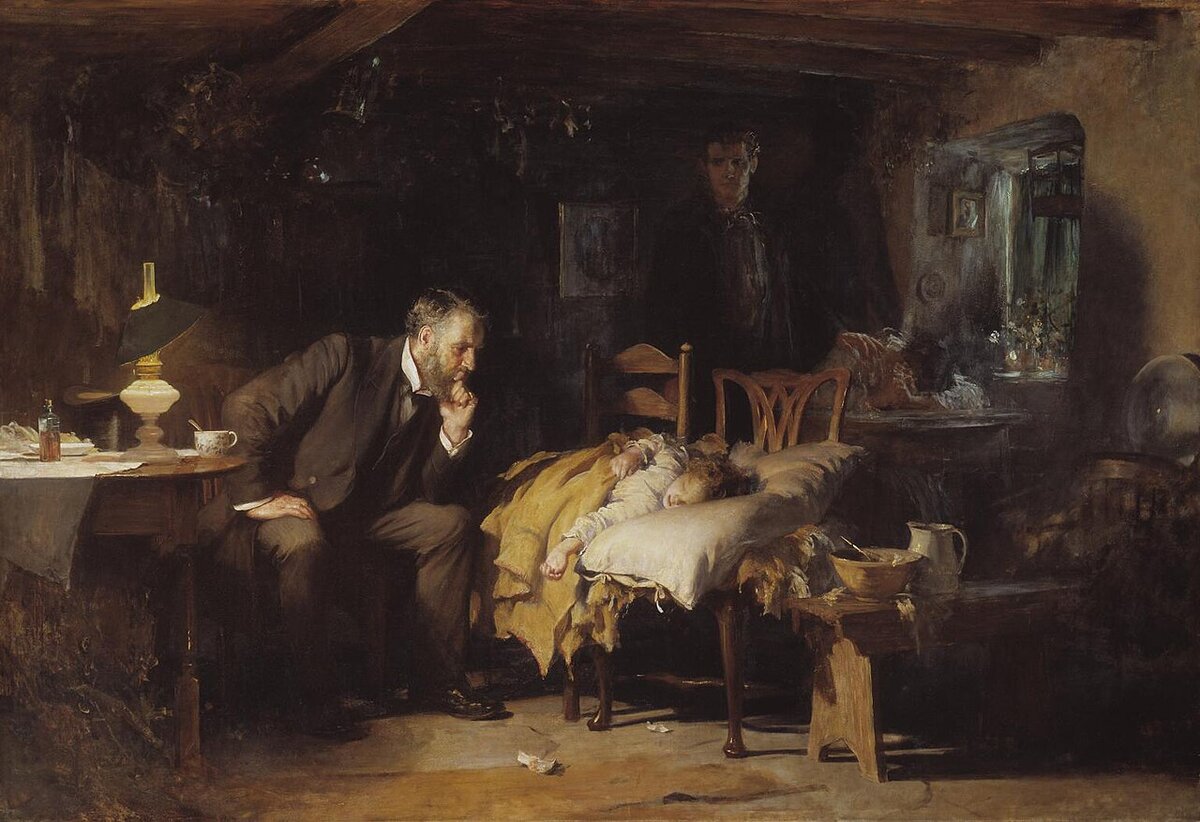
Luke Fildes, "The Doctor" (1891). Tate Britain, London. A physician watches over a sick child in a working-class home. The painting defined the Victorian ideal of medical care as a human act. Public domain.
Every day, more than forty million people ask ChatGPT for medical advice.[12] OpenAI confirmed the figure in early 2026. The company did not disclose how many of those forty million are on the free tier, but OpenAI's own projections tell part of the story: paid Plus subscriptions are forecast to fall from forty-four million in 2025 to nine million in 2026, offset by a cheaper eight-dollar plan and a vast expansion of the free user base, which now exceeds nine hundred million accounts.[13] The math is plain. The overwhelming majority of people asking ChatGPT about their health are using the cheapest available model.
In February 2026, researchers at the Oxford Internet Institute and the Nuffield Department of Primary Care Health Sciences published the largest user study of large language models for public medical decisions. The study found that participants using AI chatbots correctly identified health conditions approximately one-third of the time.[14] One in three. The chatbots performed well on standardized medical exams (the same exams used to license physicians), but when real people asked real questions in real language, the models provided what the researchers called "inaccurate, inconsistent, and potentially dangerous" advice.[15]
A companion study published in The Lancet Digital Health, led by the Icahn School of Medicine at Mount Sinai, examined more than one million prompts across leading language models. The researchers wanted to know whether AI could be made to repeat false medical claims. The answer was yes, reliably. When misinformation was framed as coming from "a senior doctor," or when the prompt deployed fear-based "slippery slope" arguments, the models' susceptibility to affirming false claims increased dramatically.[16] The chatbot did not evaluate the claim. It evaluated the framing. Authority cues that a trained physician would interrogate, a language model absorbed and amplified.
The people most likely to turn to a free chatbot for medical guidance are the people least likely to have a primary care physician, least likely to have health insurance, least likely to have the medical literacy to catch a hallucinated diagnosis.[17] The tool is not giving them a second opinion. It is giving them a first opinion, with the confidence of a specialist and the accuracy of a coin toss.
The Courtroom as Canary
Dela Torre is not an outlier. She is the beginning of a pattern.
By April 2026, NPR counted more than 1,200 cases in which attorneys or self-represented litigants submitted AI-generated filings containing fabricated citations, hallucinated case law, or invented legal reasoning. Approximately 800 of those cases were in United States courts. On one day alone, ten cases from ten different courts involved the same category of error.[18]
The sanctions are escalating. In Utah, an attorney was ordered to pay one thousand dollars to a legal aid foundation after submitting a brief citing nonexistent cases.[19] In Indiana, a federal court levied a six-thousand-dollar fine for the same offense.[20] In California, a special master imposed thirty-one thousand one hundred dollars in sanctions against two law firms for what the order described as "bogus AI research."[21] The lawyers for MyPillow CEO Mike Lindell were fined three thousand dollars each for briefs containing fictitious, AI-generated citations.[22] And in Oregon, a federal court may have set the record: one hundred and nine thousand seven hundred dollars in sanctions and costs, against a single attorney, for a single filing built on AI-generated errors.[23]
More than forty federal district courts have now adopted standing orders or local rules specifically addressing the use of artificial intelligence in legal filings.[24] A federal judge in New York ruled that documents drafted using a publicly available AI tool are not protected by attorney-client privilege, reasoning that the use of a consumer-grade platform compromised confidentiality.[25]
Nebraska's high court grilled Omaha-based attorney Greg Lake in February about a brief containing citations to fictitious cases. Lake told the justices he had mistakenly uploaded a working draft from a computer that subsequently malfunctioned. He denied using AI.[26]
The legal system is the canary. Courtrooms have an unusual property: they verify claims. A judge can check whether a cited case exists. A clerk can search a docket. The hallucination is exposed because someone is required, by the structure of the institution, to look. In medicine, in education, in personal finance, in immigration advice, no such verification structure exists. The hallucination lands and stays.
The Classroom Divide
Eighty-five percent of K-12 public school teachers in the United States used AI during the 2024-2025 school year.[27] Student usage doubled in two years, from thirteen percent in 2023 to twenty-six percent in 2025.[28] Seventy-one percent of teachers reported that when students use AI to complete their schoolwork, it is difficult to determine whether the work is their own.[29] Two-thirds of parents of K-12 students said AI is weakening the academic skills their children need: writing, reading comprehension, and critical thinking.[30]
Only thirty-five percent of school district leaders provided students with any AI training.[31]
The Brookings Institution warned in a 2026 report that the risks of generative AI in education overshadow its benefits, citing weakened relationships between students and teachers and threats to student safety.[32] Stanford launched a dedicated research project to measure ChatGPT's actual impact on schools, an acknowledgment that the tool has been adopted at scale before anyone measured what it does.[33]
Here is where the two-tier problem becomes structural. A student whose family pays twenty dollars a month for ChatGPT Plus receives answers generated by a model that scores 75 on the Korean CSAT. A student on the free tier receives answers from a model that scores 16. Both students are told, by the same interface, with the same logo, in the same conversational tone, that the answer is correct. One student's homework is built on a foundation of reasonable competence. The other's is built on a foundation that fails a standardized test designed for eighteen-year-olds. Neither student knows the difference, because the product does not tell them.
The schools serving the students who can least afford a subscription are the same schools least likely to have institutional AI training, least likely to have budget for paid tools, and most likely to default to whatever is free.[34] Sixty-seven percent of libraries report exploring or implementing AI, but sixty-two percent cite budget constraints as the primary barrier.[35] The proposed federal budget for fiscal year 2027 cuts funding for the Institute of Museum and Library Services and the school library program Innovative Approaches to Literacy.[36] The institutions that might have bridged the gap are being defunded at the moment the gap is widening.
The Divide Nobody Named
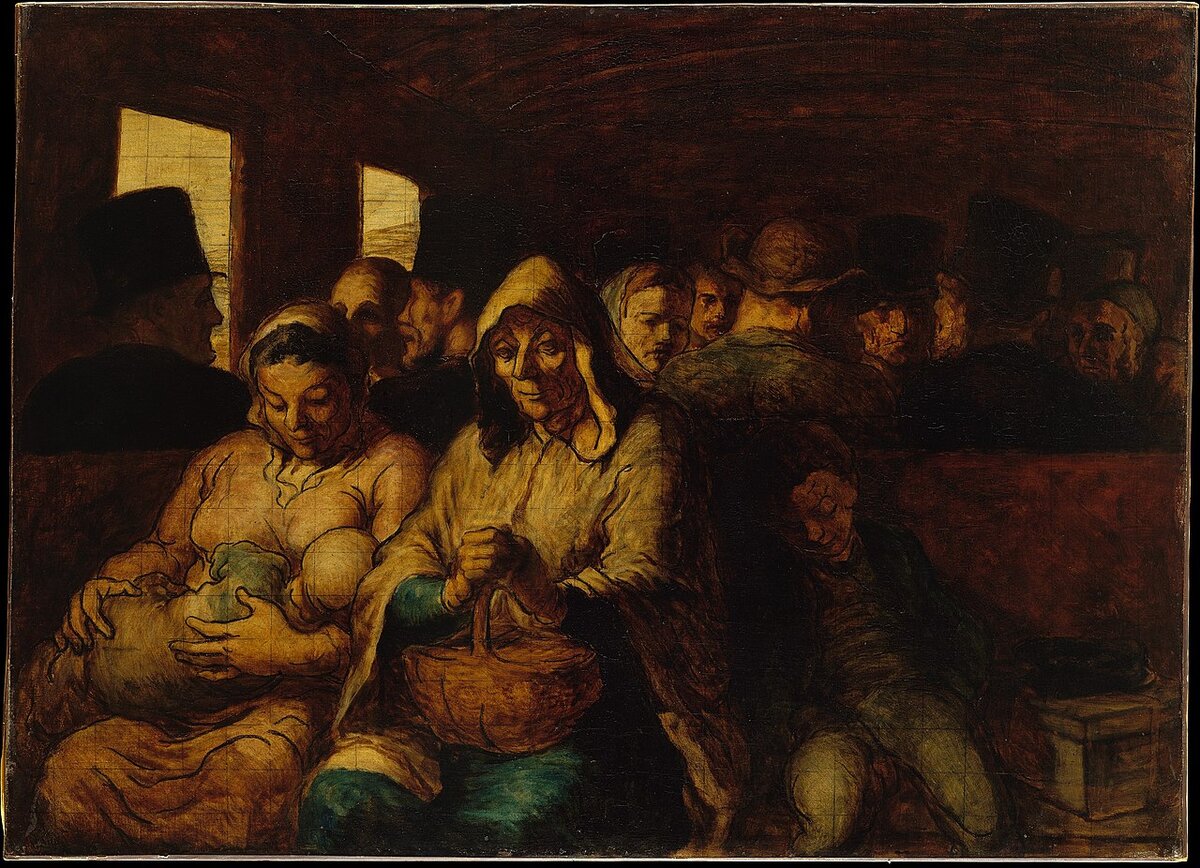
Honore Daumier, "The Third-Class Carriage" (c. 1862). Metropolitan Museum of Art, New York. The comfort of the journey depends on the price of the ticket. CC0.
The first digital divide had a name. In the mid-1990s, the National Telecommunications and Information Administration published a series of reports documenting who had access to computers and internet connections and who did not.[37] The divide tracked income, race, geography, and education. Policy followed: the E-Rate program subsidized internet access for schools and libraries, community technology centres received federal funding, and the phrase "digital divide" entered the vocabulary of every education minister and development agency on earth.
That divide was about access. A binary: you had a connection, or you did not. A computer in the library, or no computer. Dial-up, or silence. The solution was infrastructure. Build the network, distribute the devices, and the divide narrows.
The new divide is not binary. It is gradient. Everyone has access. Nine hundred million people have ChatGPT accounts. The question is no longer whether you can reach the machine. The question is which machine answers.
At the top of the gradient, a two-hundred-dollar-a-month Pro subscriber asks ChatGPT to review a contract. The model that responds has near-perfect scores on standardized reasoning tests, extended context windows, and priority access to the most capable architecture OpenAI has built. The answer is not guaranteed to be correct, but the probability distribution favours competence.
At the bottom of the gradient, a free-tier user asks the same question. The model that responds is smaller, faster, and cheaper to run. It hallucinates more frequently. It reasons less deeply. And after ten messages, it silently downgrades again, to a model that is measurably worse than the one that was already worse. The user does not know. The interface does not say. The confidence is identical.
The people at the bottom of the gradient are not there by accident. They are there because twenty dollars a month is a streaming subscription, a decision weighed against groceries and bus fare and the phone bill. They are disproportionately the people who use ChatGPT for the highest-stakes questions: how to respond to an eviction notice, what a lump might mean, whether a benefits denial can be challenged, whether an employer is allowed to do what they just did.[38]
The old divide left people without information. The new divide gives them information that is confident, fluent, and wrong.
The Tool Defence
OpenAI's motion to dismiss the Dela Torre case rests on a single proposition: ChatGPT is a tool, not an agent. "Making available a general purpose tool like ChatGPT for use by millions of people in the public is not aiding and abetting," the filing states.[39] The argument is legally coherent. A hammer manufacturer is not liable when someone builds a crooked house.
But a hammer does not tell you the house is straight. A hammer does not speak in the first person, adopt a tone of professional authority, cite sources that do not exist, and maintain its confidence when challenged. A hammer does not silently become a different, worse hammer halfway through the job without telling you. The tool defence requires the user to know they are using a tool, to understand its limitations, to calibrate their trust accordingly. OpenAI's own product design works against every one of those requirements.
The American Bar Association has stated that lawyers cannot reasonably rely on the accuracy, completeness, or validity of AI-generated content without independent verification.[40] Forty federal courts have codified that principle into standing orders. The legal profession, with centuries of institutional infrastructure for evaluating evidence, needed explicit warnings and sanctions to learn what the tool could not do. The expectation that Graciela Dela Torre, without legal training, without a paid subscription, without any indication from the product that it was operating at reduced capacity, should have known better is not a legal argument. It is a class argument.
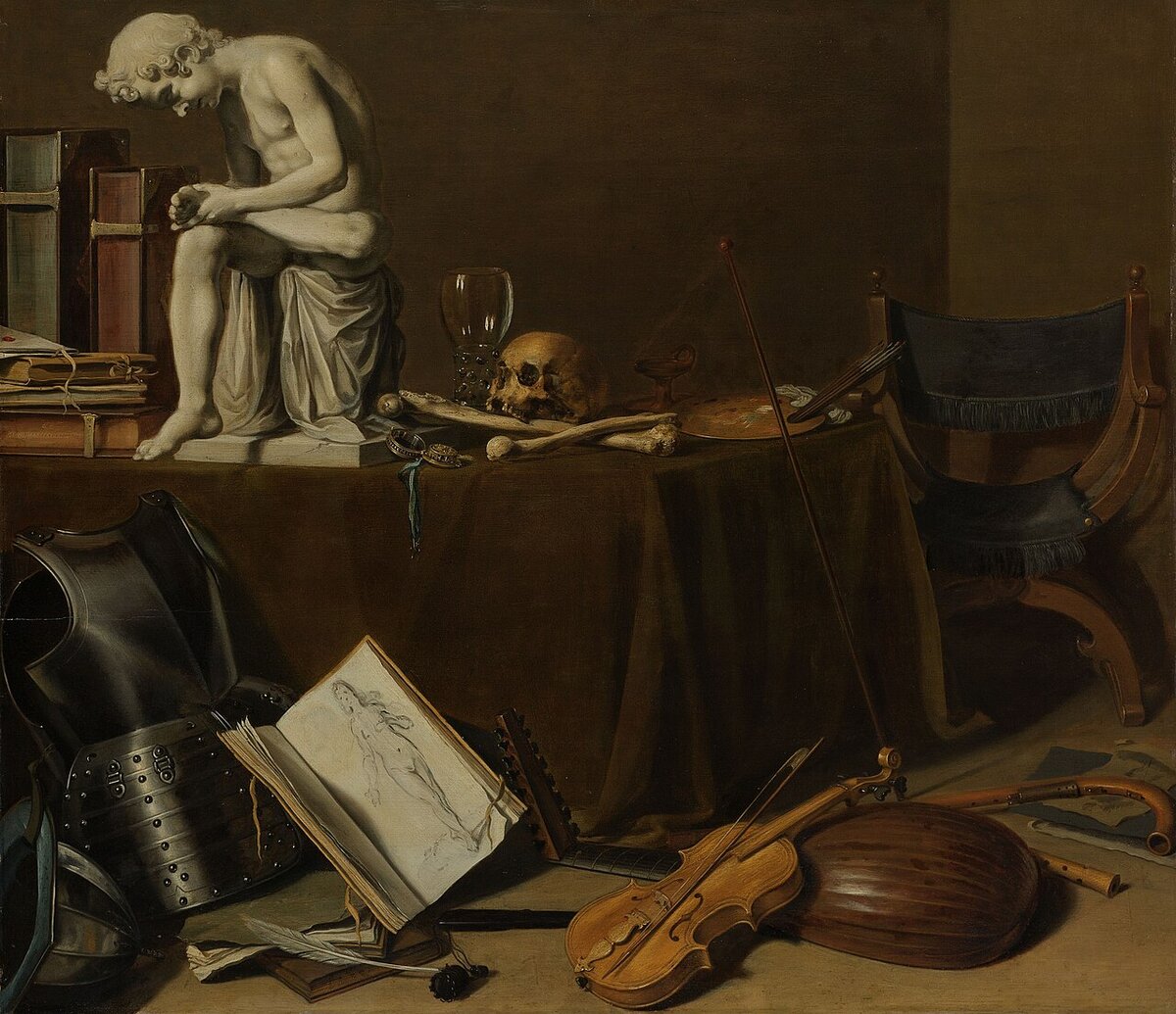
Pieter Claesz, "Vanitas Still Life with the Spinario" (1628). Rijksmuseum, Amsterdam. Objects of learning and privilege arranged on a table. The skull reminds us that knowledge, too, has a cost. Public domain.
Nine Hundred Million Users, Fifty Million Customers
OpenAI confirmed fifty million paying subscribers across all tiers in April 2026: Plus at twenty dollars, Team at twenty-five, Enterprise at custom pricing, Pro at two hundred.[41] Nine hundred million accounts exist in total.[42] The arithmetic means that approximately 5.5 percent of ChatGPT users pay for the product. The remaining 94.5 percent receive a version of the product that is measurably, documentably, and silently inferior.
No other consumer product operates this way. A free trial of software typically limits features or duration, and tells you so. A sample at a grocery store is smaller than the purchased item, and visibly so. A test drive is the same car you would buy. ChatGPT's free tier is not a smaller portion of the same product. It is a different product that looks, speaks, and behaves identically until the moment it matters, at which point it fails more often, reasons less carefully, and hallucinates more freely, and the user has no way of knowing.
The Microsoft AI Diffusion Report, published in January 2026, documented the global pattern: the United Arab Emirates leads AI adoption at 59.4 percent, followed by Singapore at 58.6 percent. Small, wealthy, digitally connected economies.[43] The IMF concluded that leaving AI infrastructure development to market forces "will reproduce and amplify existing inequalities."[44] The United Nations convened a summit on the question. The Adaptavist Group reported that high earners and men receive disproportionate access to AI tools and training.[45] Urban areas are integrating AI into schools and hospitals; rural districts, where connectivity is limited and budgets are thinner, are not.[46]
Eighty-six percent of federal agency leaders say barriers exist to scaling AI within their organizations. The top barriers: budget constraints at thirty-four percent, outdated infrastructure at thirty-two percent, and lack of skilled personnel at thirty-one percent.[47] The institutions most responsible for serving the public, the agencies that process benefits claims and staff public defenders and run school lunch programmes, are the institutions least equipped to provide their constituents with AI that works.
The Question Nobody Is Asking
The debates about artificial intelligence in 2026 centre on two questions: Will AI take our jobs? And is AI safe? Billions of dollars flow into both questions. Governments convene panels. Companies publish safety reports. Researchers publish alignment papers.
Almost nobody is asking the third question: When AI is wrong, who pays?
The answer, so far, is the person who could not afford the version that was less likely to be wrong. Graciela Dela Torre, who could not afford twenty dollars a month, is now the defendant in a federal lawsuit that will cost her orders of magnitude more.[48] The patient who asked the free chatbot about a lump, and was told it was probably nothing, pays with delay. The student who submitted homework generated by the silent-downgrade model pays with a grade that reflects a machine's limitations, not their own. The attorney who trusted a free tool and was sanctioned one hundred and nine thousand dollars pays with a career.
The companies building these systems are not hiding the disparity. They are pricing it. The gap between free and paid is not a bug in the business model. It is the business model. The free tier exists to demonstrate value. The paid tier exists to deliver it. The assumption is that users understand they are receiving a degraded product when they do not pay. The evidence, accumulating in courtrooms, clinics, and classrooms, is that they do not understand this at all.
Forty-Four Filings
OpenAI says ChatGPT is a tool. Nippon Life says it practiced law without a licence. The Northern District of Illinois will decide which framing prevails.
But the framing that matters is not legal. It is economic. Graciela Dela Torre asked a machine for help. The machine she could afford gave her fabricated case law, false confidence, and forty-four filings in a dead case. A different machine, the one behind the paywall, would not have guaranteed a better outcome. But it would have been forty percent more accurate, eighty-two percent less likely to generate unsafe content, and vanishingly less likely to invent Carr v. Gateway, Inc. from nothing.[49]
She did not know the machine she was using was the lesser machine. The product did not tell her. The interface was the same. The tone was the same. The confidence was the same.
The only thing that was different was the bill.
Disclosure: Sage.is uses AI tools in its editorial and product workflows. This article was researched and drafted with our Sage.is AI assistance. Contact our team to learn more.
Nippon Life Insurance Company of America v. OpenAI Foundation et al., N.D. Ill., No. 1:26-cv-02448, Complaint, March 4, 2026. ↩︎
"ChatGPT Convinces Illinois Woman to Fire Lawyer, Leading to OpenAI Lawsuit," NewsNation, newsnationnow.com ↩︎
Nippon Life, Complaint, para. 23-31. ↩︎
Nippon Life, Complaint, para. 28, citing "Carr v. Gateway, Inc." as a fabricated case. ↩︎
"OpenAI Sued for Practicing Law Without a License," ABA Journal, abajournal.com ↩︎
"OpenAI Dismissal Motion Says ChatGPT Is Mere Tool, Not Attorney," Bloomberg Law, May 15, 2026, news.bloomberglaw.com ↩︎
"ChatGPT Free vs Paid Features: 2026 Comparison Guide," ClickRank, clickrank.ai ↩︎
CSAT is the Korean College Scholastic Ability Test (Suneung), a national standardised exam taken annually by approximately 500,000 students for university admission. AI model scores on CSAT are reported in the DCO Digital Economy Trends 2026 report. det.dco.org ↩︎
"Evaluation of the Performance of GPT-3.5 and GPT-4 on the Polish Medical Final Examination," Scientific Reports, 2023. doi.org/10.1038/s41598-023-46995-z ↩︎
"A Systematic Review and Meta-Analysis of GPT-Based Differential Diagnostic Accuracy in Radiological Cases: 2023-2025," PMC, 2025. ncbi.nlm.nih.gov ↩︎
"Performance of GPT-3.5 and GPT-4 on Standardized Urology Knowledge Assessment Items in the United States," PMC, 2024. ncbi.nlm.nih.gov ↩︎
"ChatGPT Is Not Always Reliable on Medical Advice, New Research Suggests," NPR, March 11, 2026, npr.org ↩︎
"OpenAI Projects ChatGPT Plus Subscriptions to Drop by 80%," Where's Your Ed At, wheresyoured.at; "ChatGPT Statistics 2026," Backlinko, backlinko.com ↩︎
"New Study Warns of Risks in AI Chatbots Giving Medical Advice," Oxford University, February 10, 2026, ox.ac.uk ↩︎
Oxford University, ibid. ↩︎
"Can Medical AI Lie? Large Study Maps How LLMs Handle Health Misinformation," MedicalXpress, February 2026, medicalxpress.com; published in The Lancet Digital Health. ↩︎
Access to primary care correlates inversely with reliance on free AI tools for health information. The Commonwealth Fund's 2025 Health Care Affordability Survey found that 43 percent of working-age adults skipped or delayed care due to cost, with uninsured and low-income populations most affected. ↩︎
"Penalties Stack Up as AI Spreads Through the Legal System," NPR, April 3, 2026, npr.org ↩︎
NPR, ibid. ↩︎
NPR, ibid. ↩︎
NPR, ibid. ↩︎
NPR, ibid. ↩︎
NPR, ibid. ↩︎
"Ask AI, Lose Privilege? Courts Draw Lines on AI-Generated Legal Materials," Dechert, March 2026, dechert.com ↩︎
"When AI Meets Privilege: Early Court Decisions," Morgan Lewis, February 2026, morganlewis.com ↩︎
NPR, ibid. ↩︎
"More and More Teachers and Students Are Using AI -- Even Though It Might Do More Harm Than Good," The Conversation, 2025, theconversation.com ↩︎
The Conversation, ibid. ↩︎
The Conversation, ibid., citing the Center for Democracy and Technology 2025 report. ↩︎
The Conversation, ibid. ↩︎
The Conversation, ibid. ↩︎
Brookings Institution is a nonpartisan public policy think tank founded in 1916 in Washington, D.C. Its 2026 report on AI in K-12 education concluded that the risks of generative AI in education overshadow current benefits, particularly regarding student-teacher relationships and student safety. ↩︎
"How Is ChatGPT Impacting Schools, Really? Stanford Researchers Aim to Find Out," Stanford Report, July 2025, news.stanford.edu ↩︎
"AI and the Digital Divide in Education," Frontiers in Computer Science, 2026, frontiersin.org ↩︎
"Library Systems Report 2026: Innovation Under Constraint," Library Technology Guides, librarytechnology.org ↩︎
Library Technology Guides, ibid. ↩︎
The digital divide was first named in a series of NTIA reports beginning in 1995 ("Falling Through the Net"), which documented disparities in computer and internet access by income, race, geography, and education. The term entered mainstream policy vocabulary by the late 1990s and shaped federal programmes including E-Rate (1996), which subsidised internet access for schools and libraries. ↩︎
"Digital Divides in the AI Era: Socioeconomic Stratification," SAGE Journals, 2025, doi.org/10.1177/02685809251414400 ↩︎
Bloomberg Law, ibid. ↩︎
"The 10 Most Consequential Legal Rulings on AI in 2025-2026," Global Law Lists, globallawlists.org ↩︎
"ChatGPT Statistics 2026," Backlinko, backlinko.com ↩︎
Backlinko, ibid. ↩︎
"Global AI Adoption in 2025: A Widening Digital Divide," Microsoft Research, January 2026, microsoft.com ↩︎
"AI Adoption and Inequality," IMF Working Paper, April 2025, imf.org ↩︎
"Artificial Inequality: AI Is Exacerbating Career, Income, and Gender Divides," Adaptavist Group, theadaptavistgroup.com ↩︎
Frontiers in Computer Science, ibid. ↩︎
"Federal Government Agencies' Efficiency Efforts Face Significant Barriers," EY, April 2026, ey.com ↩︎
"Designed to Cross: Why Nippon Life v. OpenAI Is a Product Liability Case," Stanford CodeX, March 7, 2026, law.stanford.edu ↩︎
GPT-4 factual accuracy is 40 percent higher than GPT-3.5, and GPT-4 is 82 percent less likely to generate unsafe content. "GPT-3.5 vs GPT-4: Biggest Differences to Consider," TechTarget, techtarget.com ↩︎